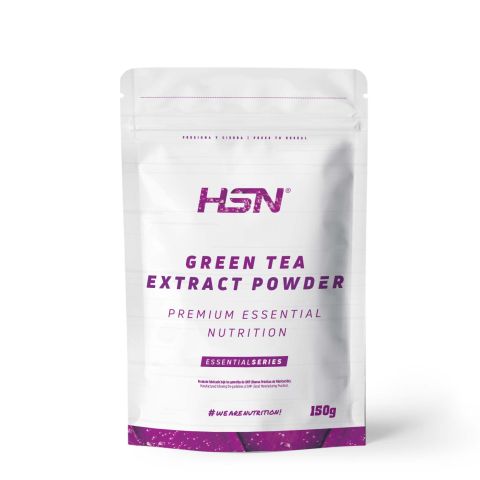
Green tea extract 26:1: more concentrated and versatile
Green tea extract (26:1) powder from EssentialSeries is a food supplement made from the leaves of Camellia sinensis, the plant from which green tea is obtained. We’ve gone for a 26:1 concentrated raw material, meaning it’s a much more concentrated extract than regular powdered leaf and also more advanced than our previous classic 8:1 extract version.
With this raw material upgrade, we take a step further in concentration and quality: now we work with a 26:1 extract standardized in polyphenols, catechins, EGCG, and caffeine, so you know exactly what you’re adding to your routine.
This product is designed for those who want to enjoy green tea in a different format than infusion and more flexible than capsules. Since it comes in powder form, you can prepare it as a drink, add it to your smoothies, mix it with yogurts, or easily include it in cold recipes. It’s a convenient option for those who prefer to customize their intake, adjust the timing, and avoid encapsulated formats.
A concentrated green tea extract with no additives, created for those looking for a quality presentation that’s easy to integrate into their daily routine.
What makes this green tea extract different?
Green tea is one of the most well-known ways to consume Camellia sinensis. Traditionally, it’s taken as an infusion, but a powder extract isn’t exactly the same as brewing a cup of tea. In an infusion, the leaf compounds pass into the water during preparation time; in an extract, we work with a raw material obtained to concentrate the plant’s characteristic components.
That’s why one of the most important points of this product is its 26:1 ratio. This ratio indicates that the extract comes from a larger amount of green tea leaf compared to the final extract obtained. Simply put: we’re not talking about just ground green tea leaf, but a concentrated green tea leaf extract. This detail is key to differentiate it from other formats like green tea bags, powdered leaf, or even matcha, which is ground leaf and not a concentrated dry extract.
Also, this extract is standardized. That means we don’t just list the ingredient but also its main composition markers: 50% polyphenols, 30% catechins, 15% epigallocatechin-3-gallate, known as EGCG, and 8.5% caffeine. For beginners, this translates into a more transparent formula. For advanced users, it means they can precisely know the extract’s profile and better assess the raw material’s quality.
Why is standardization important? Because not all plant extracts are the same. At HSN, we prefer to specify the characteristic compounds of green tea so you can know what the product really offers beyond just the ingredient name.
Clear composition to understand what you’re taking
Green tea naturally contains different plant compounds. Among the best known are polyphenols, a broad group of substances found in many plants, and within them, catechins, which are especially representative of green tea.
In our extract, we’ve defined the composition specifically: 50% corresponds to polyphenols and 30% to catechins. Within the catechins, we find EGCG, one of the most characteristic fractions of green tea and one of the most used markers to assess the concentration of this type of extract. In our extract, the EGCG content is 15%.
It also naturally contains caffeine, with 8.5% declared in the composition. This is important because it means our green tea extract is not decaffeinated; it does contain caffeine, so it might be more interesting to use it in the morning or early hours of the day, especially if you’re sensitive to caffeine, although the net caffeine intake is relatively low, so for most users it won’t interfere with their rest.
A good extract should have all the information available. It’s not enough to say “green tea”: the quality of its nutritional components is also important. The part used, the type of extract, and the concentration are key, all of which you can find in our 26:1 green tea leaf powder extract.
Powder format: the most versatile alternative to capsules
One of the great values of this product is its format. Capsules are practical for those looking for a quick intake, but powder offers something different: more freedom of use. You can mix it with water, prepare it as a drink, add it to a smoothie, combine it with a plant-based drink, or include it in cold recipes. This makes it a very interesting option for those who already have a routine of shakes, bowls, or functional blends.
The powder format also allows you to enjoy the green tea extract as is. Green tea extract has a vegetal, intense, herbal, and slightly bitter or astringent taste. It’s a natural characteristic of this type of concentrated extracts, especially when no flavors, sweeteners, or ingredients are added to mask its taste.
If you like botanical flavors, you can take it simply mixed with water. If you prefer to soften it, you can combine it with fruit smoothies, plant-based drinks, yogurt, or recipes with cocoa, cinnamon, vanilla, or rounder-flavored ingredients. This way, you can integrate it more pleasantly without giving up a pure, additive-free formula.
Powder is for those who want more than just “taking a capsule”: it allows you to prepare, mix, and adapt green tea extract to different times of day and ways of consumption.
A clean label, plant-based, and additive-free formula
Green tea extract (26:1) powder fits within our approach to plant-based food supplements: clear formulas, quality ingredients, and transparent composition. In this case, we’re talking about a natural green tea leaf extract, with no additives and suitable for vegan diets.
It’s a 100% pure product since it only contains green tea extract itself. We haven’t sought a formula with blends but a pure, concentrated, standardized, and quality raw material so you can combine it yourself with other products if you want.
Who uses it?
This green tea extract fits well with different profiles. If you’re starting out in the world of food supplements, it might interest you because it’s a single, very versatile ingredient: green tea. If you already consume infusions, it can be a more concentrated and practical way to include it in your routine without having to prepare a cup every time.
It’s also an interesting option for wellness users looking for quality ingredients in versatile formats. Since it can be mixed with drinks or recipes, it’s especially convenient for those who already prepare shakes, smoothies, or daily blends.
For more advanced users, the main attraction is the standardization: 26:1 ratio, 50% polyphenols, 30% catechins, 15% EGCG, and 8.5% caffeine. These data allow better comparison of the raw material and understanding that this isn’t a generic green tea product but a defined and concentrated extract.
Green tea supports metabolism and fat oxidation, helps boost energy, strengthens the body’s antioxidant defenses, and helps maintain normal or healthy cholesterol levels.
How to use it in your routine
The easiest way to use this extract is to mix it with water. Since it’s a concentrated powder, we recommend stirring it well and adjusting preparation to your taste. Some people prefer to dissolve it first with a small amount of warm water and then add cold water, plant-based drink, or the chosen liquid, as this can help achieve a more pleasant mix.
You can also add it to fruit smoothies, yogurt blends, bowls, plant-based drinks, or cold recipes. Due to its herbal and slightly bitter taste, it pairs especially well with milder or sweeter flavors like banana, apple, oat drink, pure cocoa, cinnamon, or vanilla.
If you use it within a sports or active lifestyle routine, you can include it in a daily drink along with other powdered products. If you prefer it within a general wellness routine, it can fit well with greens, for example.
Combination ideas
This extract can be easily combined with other products, always from a practical approach and without needing complicated formulas. For example, it can fit with Chlorella powder or Kale powder if you want to prepare a plant-based blend. It can also be added to smoothies with plant protein or whey protein, or to drinks with collagen if you follow a nutricosmetic routine.
Our recommendation is to keep an easy-to-follow routine: few ingredients but quality ones and simple preparation that’s easy to repeat.
Frequently asked questions about the extract
Is it the same as a green tea infusion?
No. An infusion is prepared with green tea leaves in water, while this product is a concentrated powder extract. Both come from Camellia sinensis, but they’re not the same format nor have the same concentration.
Is it the same as matcha?
No. Matcha is ground green tea leaf, while this product is a 26:1 green tea leaf extract. The extract is designed to concentrate characteristic plant compounds and is also standardized in polyphenols, catechins, EGCG, and caffeine.
Why is the 26:1 ratio important?
Because it tells us it’s a concentrated extract. In this case, we’ve gone from an 8:1 raw material to a 26:1, which allows us to offer a more concentrated option with a superior composition for those looking for an advanced plant extract.
Does it contain caffeine?
Yes. The product declares 8.5% naturally present caffeine, with a relatively low intake (17 mg in the recommended serving). If you’re sensitive to caffeine, it might be better to take it in the morning or early hours of the day, although for many people this amount of caffeine won’t significantly affect any part of their day or night.
What does it taste like?
It has a vegetal, intense herbal taste that’s slightly bitter or astringent. It’s the typical flavor of a 100% pure concentrated green tea extract.
Can it be mixed with shakes?
Yes. In fact, that’s one of the main advantages of the powder format. You can mix it with water, smoothies, plant-based drinks, yogurt, or cold recipes.
Is it suitable for vegans?
Yes.
Can I take it on an empty stomach?
No. It should not be taken on an empty stomach.
Why choose it over others
Because we’ve chosen a format that goes beyond capsules and traditional infusion. This powder extract lets you prepare green tea more flexibly, adapt it to your blends, and enjoy a concentrated, standardized, additive-free raw material.
If you’re looking for a pure, quality green tea extract, this is a practical, concentrated, and versatile option to integrate into your daily routine.
Bibliography
- Cabrera, C., Artacho, R., & Giménez, R. (2006). Beneficial effects of green tea—a review. Journal of the American College of Nutrition, 25(2), 79-99.
- Vuong, Q. V., Golding, J. B., Nguyen, M., & Roach, P. D. (2010). Extraction and isolation of catechins from tea. Journal of Separation Science, 33(21), 3415-3428.
- Musial, C., Kuban-Jankowska, A., & Gorska-Ponikowska, M. (2020). Beneficial properties of green tea catechins. International Journal of Molecular Sciences, 21(5), 1744.
- Koch, W., Kukula-Koch, W., Komsta, L., & Marzec, Z. (2018). Black tea samples origin discrimination using analytical investigations of secondary metabolites, antiradical scavenging activity and chemometric approach. Molecules, 23(3), 513.
- European Food Safety Authority. (2018). Scientific opinion on the safety of green tea catechins. EFSA Journal, 16(4), e05239.