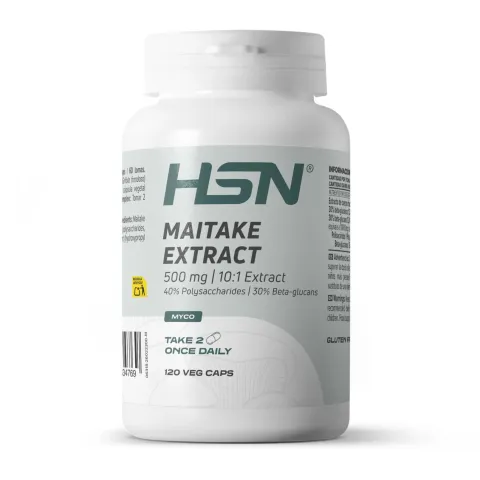
Maitake 10:1 from Myco Nutrition: standardized extract, clean label, and quality
Maitake Extract (10:1) 500mg from Myco Nutrition is a dietary supplement made from Grifola frondosa, an edible mushroom popularly known as maitake. Its name comes from Japanese tradition and is often translated as “dancing mushroom,” a curious way to refer to an ingredient that has sparked interest for years both for its culinary use and its natural composition of fungal polysaccharides.
With Myco Nutrition, at HSN we take a step further into the world of mushrooms. We didn’t want to create a generic range, but a line with its own identity, focused on selected fungal raw materials, concentrated extracts, clear standardizations, and easy-to-understand formulas. That’s why our maitake is a single-ingredient extract, clean label, highly concentrated, and designed for those who want to add mushrooms to their daily routine in a simple way.
Myco Nutrition was born with a very clear idea: to bring mushrooms closer through quality raw materials, real standardization, and clear explanations, so you know what you’re taking and why you choose it.
The value of our formula lies in three key points: we use a 10:1 extract, standardize it to 40% polysaccharides, and guarantee 30% β-glucans 1,3/1,6. This matters because not all mushroom extracts are the same. Some products only say “mushroom powder” or “total polysaccharides,” but they usually don’t specify the β-glucan content, which is one of the most characteristic and sought-after fractions in mushrooms.
500mg of maitake 10:1 extract per capsule, standardized to 40% polysaccharides and 30% β-glucans 1,3/1,6.
A clear and transparent formula within the new Myco Nutrition line from HSN.
Maitake isn’t understood as an isolated ingredient but as a complex matrix. Its composition includes polysaccharides, β-glucans, heteropolysaccharides, proteins, small amounts of phenolic compounds, sterols, and other mushroom-specific components. That’s why we’ve taken care to control all the necessary quality aspects to produce this maitake extract.
The standardization that makes the difference
Standardization is one of the most important aspects of our extract. When we talk about mushroom extracts, it’s not enough to say they contain maitake. It’s also important to know what concentration of characteristic compounds the final extract provides. That’s why we highlight the most relevant data: 40% polysaccharides and 30% β-glucans 1,3/1,6.
Polysaccharides are complex carbohydrates naturally present in mushrooms. Among them, β-glucans are especially interesting because they are part of the fungal structure and help differentiate a quality extract from a basic raw material. Also, in mushrooms, β-glucan 1,3/1,6 structures are particularly representative, as they are associated with the matrix of species like maitake.
This point is important because “polysaccharides” and “β-glucans” don’t mean exactly the same thing. An extract may declare total polysaccharides, but that doesn’t necessarily tell us how much corresponds to β-glucans. At Myco Nutrition, we wanted to go further by providing a double standardization that helps better understand the ingredient’s quality: on one hand, a high content of total polysaccharides; on the other, a specific content of β-glucans 1,3/1,6.
More transparency, better judgment: we don’t just say the product contains maitake, but also what concentration of polysaccharides and β-glucans our extract provides.
This standardization allows us to offer a clearer datasheet and a more coherent formula. We don’t rely solely on maitake’s prestige as a mushroom but on a defined, concentrated, and controlled raw material. For you as a consumer, this translates into something very simple: you know you’re taking a maitake extract with a specific and quality nutritional profile, not a generic powder without specification.
Quality raw material: fruiting body of Grifola frondosa
When we formulate a Myco Nutrition product, we don’t just look at the mushroom’s name. It’s important for us to consider where the raw material comes from, what part is used, how the extract is obtained, and what type of compounds we want to preserve. In the case of maitake, we prioritized the fruiting body, the visible part of the mushroom and the most valued when seeking a complete and representative profile.
This choice helps us offer an ingredient more directly linked to maitake as a whole mushroom. At Myco Nutrition, we wanted to work with a selective raw material from a quality perspective: the fruiting body of Grifola frondosa.
We also chose a 10:1 extract because it allows us to work with a more concentrated form than conventional powder. Simply put: to get one part of extract, 10 parts of maitake raw material are used. This means the product is 10 times more concentrated.
This combination of fruiting body, concentrated extraction, and high standardization is what makes our extract a high-quality option. It’s not just about including maitake in a capsule but offering a carefully crafted version of the mushroom, with thoroughly controlled quality criteria.
Clean label: because our maitake doesn’t need frills
The clean label approach is an essential part of our product. At HSN, we believe a good mushroom extract doesn’t need a complicated formula to be interesting. If the raw material is good, the concentration well defined, and the standardization clear, the most coherent thing is to build a simple, clean capsule without unnecessary ingredients.
That’s why Maitake Extract (10:1) 500 mg from Myco Nutrition is designed as a vegan, gluten-free, non-GMO formula aligned with our transparency philosophy. We want the maitake extract to take center stage, not a long list of excipients or added ingredients that don’t add real value to the product.
For us, clean label means formulating with sense: choosing raw materials well, declaring what matters, and avoiding complicating a product that is naturally excellent due to its intrinsic quality.
A fungal matrix rich in characteristic maitake compounds
The main value of maitake lies in its composition. In research, Grifola frondosa has been especially studied for its polysaccharide fractions, including β-glucans, heteropolysaccharides, and proteoglycans. Some specific fractions have been used in scientific studies to better understand the behavior of maitake polysaccharides.
In our case: we used a maitake extract 10:1 standardized to 40% polysaccharides and 30% β-glucans 1,3/1,6.
Within Myco Nutrition, we want each mushroom to have its own space. Maitake stands out for its polysaccharide and β-glucan profile; other mushrooms may have a focus more associated with tradition, general wellness, or specific routines. This differentiation allows us to build a broad and useful range for all interests, without mixing all mushrooms under the same goal.
Who is this product for
Maitake Extract (10:1) 500mg is designed for people who want to add mushrooms to their daily life in a simple way. It’s an interesting option if you already know ingredients like reishi, shiitake, cordyceps, chaga, or lion’s mane, and want to expand your routine with a different mushroom, especially focused on polysaccharides and β-glucans.
It can also fit if you’re interested in advanced nutrition, daily wellness, and natural-origin dietary supplements but prefer simple, quality formulas without unnecessarily complex blends. Instead of combining many ingredients in one capsule, here we offer an individual maitake extract so you can integrate it according to your preferences and combine it with other products in a personalized way.
For beginners and advanced users: If you’re starting with mushrooms, maitake is easy to understand and take. If you already have experience, its standardized 10:1 extract lets you include it as an individual ingredient within a more complete routine.
How to take Maitake 10:1 from Myco Nutrition
We always recommend following the usage instructions on the package. Generally, mushroom extracts are taken with a meal, especially if you prefer to integrate them into a stable and comfortable daily routine. Taking them with food can make the experience easier, especially for people sensitive to taking supplements on an empty stomach.
Consistency is more important than seeking a “perfect” intake. You can take it at the time of day that suits you best: breakfast, lunch, or dinner. Ideally, associate it with a habit you already have, like your first meal of the day or your usual supplement routine.
HSN tip: if you already use other mushrooms, you can alternate or combine them according to your routine goal. The important thing is to maintain a clear pattern, not to accumulate products without criteria.
The capsule format also helps keep the experience simple. Maitake as a food has its own taste and texture, but it’s not always easy to include regularly in the diet. In capsules, the extract doesn’t alter the flavor of your meals and allows you to maintain a comfortable daily routine.
Recommended combinations within a Myco Nutrition routine
Maitake pairs especially well with other natural-profile ingredients and formulas aimed at daily wellness. We can integrate it into mushroom routines, basic supplementation plans, or more complete programs seeking a varied and easy-to-maintain composition.
- Reishi: another classic mushroom, widely used in natural supplementation routines.
- Cordyceps: a common choice within routines and formulas with functional mushrooms.
- Lion’s mane: one of the most recognized mushrooms within Myco Nutrition routines.
You can use Maitake Extract (10:1) 500mg as a standalone product or integrate it into a broader routine.
Frequently asked questions about Maitake Extract (10:1) 500 mg
What does it mean that it’s standardized to 40% polysaccharides?
It means the final extract provides a defined concentration of polysaccharides, complex compounds naturally present in mushrooms. This data helps differentiate it from conventional powder or an extract without clear specification.
And what does 30% β-glucans 1,3/1,6 mean?
It means a significant part of the extract corresponds to β-glucans with 1,3/1,6 structures, characteristic of mushrooms. This data is especially relevant because not all polysaccharides are β-glucans.
Are maitake and Grifola frondosa the same?
Yes. Maitake is the common Japanese name for Grifola frondosa. It’s also known in English as hen-of-the-woods.
What does it mean that it’s a 10:1 extract?
It means 10 parts of maitake raw material were used to obtain 1 part of extract. It’s a simple way to express the extract’s concentration level. We chose this format because it allows us to offer a more advanced presentation than conventional powder.
Why is it important that it comes from the fruiting body?
The fruiting body is the visible part of the mushroom and one of the most valued in supplementation. Using this part, we get a more representative extract of maitake as a whole mushroom.
Is it a clean label product?
Yes. We designed it as a clean label, vegan, gluten-free, non-GMO formula without unnecessary ingredients. The maitake extract takes center stage, with clear standardization and an easy-to-understand composition.
Why choose Maitake Extract (10:1) 500mg from Myco Nutrition
Because we wanted to offer a clear, concentrated, standardized maitake that’s easy to integrate into your routine. We didn’t create a confusing formula with too many ingredients but an individual extract of Grifola frondosa with a 10:1 concentration, 500mg per capsule, 40% polysaccharides, and 30% β-glucans 1,3/1,6. That way, you know exactly what you’re taking.
Myco Nutrition was born to give mushrooms the space they deserve within HSN. A specialized brand lets us better explain each ingredient, differentiate their characteristics, and work on products with a clearer identity. In this case, the star is maitake: a mushroom with a matrix rich in polysaccharides and β-glucans, presented in a concentrated, clean label, practical form aligned with our quality philosophy.
Bibliography
- Gargano, M. L., van Griensven, L. J. L. D., Isikhuemhen, O. S., Lindequist, U., Venturella, G., Wasser, S. P., & Zervakis, G. I. (2021). Medicinal mushrooms: Valuable biological resources of high exploitation potential. Plant Biosystems, 155(3), 548-565.
- He, X., Wang, X., Fang, J., Chang, Y., Ning, N., Guo, H., Huang, L., Huang, X., & Zhao, Z. (2017). Structures, biological activities, and industrial applications of polysaccharides from mushrooms. International Journal of Biological Macromolecules, 97, 228-237.
- Venturella, G., Ferraro, V., Cirlincione, F., & Gargano, M. L. (2021). Medicinal mushrooms: Bioactive compounds, use, and clinical trials. International Journal of Molecular Sciences, 22(2), 634.
- Deng, G., Lin, H., Seidman, A., Fornier, M., D'Andrea, G., Wesa, K., Yeung, S., Cunningham-Rundles, S., Vickers, A. J., & Cassileth, B. (2009). A phase I/II trial of a polysaccharide extract from Grifola frondosa (Maitake mushroom) in breast cancer patients: Immunological effects. Journal of Cancer Research and Clinical Oncology, 135(9), 1215-1221.
- Cerletti, C., Esposito, S., & Iacoviello, L. (2021). Edible mushrooms and beta-glucans: Impact on human health. Nutrients, 13(7), 2195.
- Wu, J.-Y., Siu, K.-C., & Geng, P. (2021). Bioactive ingredients and medicinal values of Grifola frondosa (Maitake). Foods, 10(1), 95.