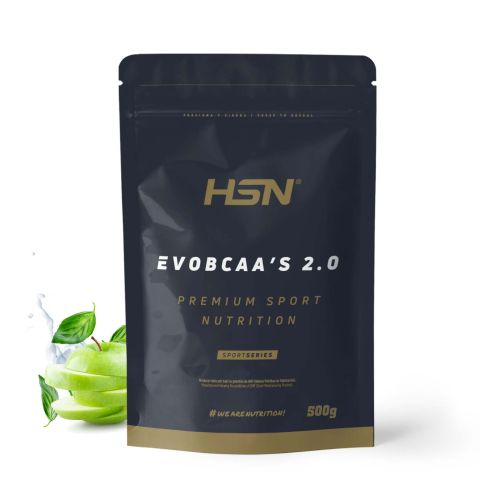
Evobcaa's 2.0 - BCAA's 12:1:1 + Glutamine from HSN
Evobcaa's 2.0 (BCAA's 12:1:1 + Glutamina) from SportSeries is HSN's most emblematic product as the representative of the options based on branched-chain amino acids, with sweeteners. It contains a combination of the 3 branched-chain amino acids and glutamine, in a 12-1-1 + 5 ratio.
Branched-chain amino acids, or BCAA's, are a group of essential amino acids that share certain concrete chemical properties that make them a highly sought option for their nutritional properties, especially among athletes, people with specific amino acid requirements, and workers exposed to large energy demands, as well as older adults.
Evobcaa's 2.0 is the 'sure-fire hit' in terms of branched amino acids; if you don’t know which amino acids to pick to complement your training, with Evobcaa's 2.0 you’ll surely hit the mark.
Discover the ultimate combination of branched amino acids
L-Leucine + L-Isoleucine + L-Valine. The 3 branched-chain amino acids: The essential amino acids consist of a total of 9 amino acids: Leucine, Isoleucine, Valine, Lysine, Methionine, Threonine, Tryptophan, Histidine and Phenylalanine. You’ve probably noticed the first 3 are the BCAA's.
And that’s right, the BCAA's are a specific group of amino acids, with their own identity for being branched, that is, their R group (the variable part of the amino acid) has a carbon branch. This feature gives them unique properties, such as their important role in various biological processes in the body.
Occasionally, many products theoretically made 'based on BCAA's' don’t contain only BCAA's, but are mixed with a wide variety of amino acids of other types, which ultimately are cheaper and not as specific to the properties of their branched versions, like the branched-chain amino acids.
Evobcaa's 2.0 from HSN has a combination of the 3 branched amino acids, in significant proportions, transparently and without 'cutting' or camouflaging their content.
With added Glutamine, why is it present in Evobcaa's 2.0?: You might wonder why a product based on BCAA's contains glutamine, when this amino acid is not a branched-chain amino acid, nor even an essential amino acid.
Truth is that glutamine is an amino acid that when we talk about athletes, or people with heavy muscle wear, regardless of its origin, becomes conditionally essential; since it is the amino acid that is present in the greatest amount in muscle tissue, and when this is compromised, the body becomes a big consumer of glutamine.
That is why after looking at studies and consumer analyses, we realized that more than 80% of them combined BCAA's with Glutamine, buying them separately to benefit from the properties that the amino acids provide together.
We wanted to develop, therefore, our most 'all-terrain' BCAA product with a blend of branched amino acids and glutamine, so that people looking for an easy, complete blend adaptable to different needs can find it easily. But you also have HSN BCAA products that don’t include added glutamine, for example:
Relation 12:1:1, why did we choose this specific mix?: When we talk about BCAA's we’re always referring to the presence of the 3 amino acids that are part of the branched-chain group, but it’s important to consider that the mix of these has to be prepared in a specific ratio, but... which is the best?
There isn’t a unanimous scientific answer to this, which is why at HSN you’ll find BCAA-based products with different ratios of Leucine:Isoleucine:Valine.
In the case of Evobcaa's 2.0 the ratio is 12:1:1, much more leaning toward Leucine, this was done deliberately since Leucine is the most studied amino acid in isolation from the BCAA group, and therefore has received special attention among them, being proposed as the star of this group of amino acids.
Kyowa® - Glutamine patent - Learn more about it
Kyowa Quality® is a registered trademark of Kyowa Hakko Bio Co., Ltd., representing a line of ultrapure amino acids, including L-Glutamine, the amino acid of Evobcaa's 2.0 with a registered trademark. The amino acids we use are obtained through plant-based fermentation processes, guaranteeing high quality and purity.
L-Glutamine Kyowa® is recognized for its efficacy and safety, being one of the most used in scientific studies worldwide.
Kyowa Hakko Bio Co., Ltd. is a Japanese biotechnology and fermentation leader. Its mission is to contribute to global health and well-being by creating new values through advances in life sciences and technologies. The company has developed innovative fermentation technologies to produce amino acids, nucleotides and other bioactive compounds. Its products, derived from plant sources, are used in different industries by leading firms, like HSN, where the use of Kyowa® stands out for its quality.
Flavors of Evobcaa's 2.0, what you should know?
If you’re not an experienced powder supplement user, specifically in RAW format, you should know that the natural flavor of ultra-pure amino acids, especially leucine, is characteristically bitter; it’s not unpleasant for someone who knows the taste, but it’s very noticeable.
This has led to different market situations:
- On one hand, many companies haven’t paid special attention to developing flavors for their BCAA's, ending up with products that still taste intensely bitter of the base amino acids.
- Other companies have obsessed over completely masking the flavor of BCAA's, using a huge amount and variety of additives, flavors, sweeteners and other compounds that end up significantly reducing the amino acid content of the product.
At HSN we’ve chosen our own solution: We didn’t want to launch a BCAA product with such a noticeable taste of the amino acids, for that you already have the RAW BCAA in uncamouflaged flavor; but we weren’t willing to add massive amounts of flavors and sweeteners just to mask the natural taste of our amino acids.
In Evobcaa's 2.0 you’ll find a balanced product: When preparing the BCAAs, you’ll notice a slightly bitter background from the amino acids, but it’s very faint since it’s well camouflaged with the developed flavors, which pair perfectly with the natural taste of the amino acids, and they’ve been developed without adding large amounts of additives, not sacrificing content or the nutritional quality of our product.
Find it available in fresh and mild flavors, fruit-type (like apple, or cherry), or soda style (like cola or energy drink); you also have different options like peach ice cream with a deeper, more complex taste.
Sporting uses of the BCAA's, when to take them?
BCAA's are amino acids closely tied to sports use, since athletes are the main group interested in this specific amino acid; however there is a lot of mysticism around when to use them.
BCAA's can be used at any time of the day to take advantage of their effects, since the body has a 'pool' of amino acids where they end up, and their action is not immediate except in certain cases of extreme need.
However, many athletes still seek the specifically ideal moment to use BCAA's, is it better before, during or after training?
As a standard recommendation, you can use Evobcaa's freshly upon waking to break the nightly fast, before breakfast. And perform another dose of the amino acids while you train. This complements perfectly with the habitual intake of protein before and/or after training.
If you don’t use protein as pre- or post-workout, then you can mix the total daily dose of Evobcaa's in a considerable amount of water and start taking them before training, extending their use throughout the entire session until it ends.
Combine Evobcaa's 2.0 with other products
Evobcaa's 2.0 doesn’t need to be combined with other elements, as it itself is a complete amino acid blend for the interest it serves.
However, it has no specific contraindications of any kind, so it’s entirely valid (and in fact a lot of people use it) in combination with different isolated amino acids, or with flavored-free carbohydrates.
Bibliography
- Castell, L. M., & Newsholme, E. A. (2001). The relation between glutamine and the immunodepression observed in exercise. Amino Acids, 20(1), 49–61.
- Castell, L. M., Poortmans, J. R., & Newsholme, E. A. (1996). Does glutamine have a role in reducing infections in athletes? European Journal of Applied Physiology and Occupational Physiology, 73(5), 488–490.
- Coqueiro, A. Y., Rogero, M. M., & Tirapegui, J. (2019). Glutamine as an Anti-Fatigue Amino Acid in Sports Nutrition. Nutrients, 11(4).
- Cruzat, V., Macedo Rogero, M., Noel Keane, K., Curi, R., & Newsholme, P. (2018). Glutamine: Metabolism and Immune Function, Supplementation and Clinical Translation. Nutrients, 10(11), 1564.
- Fouré, A., & Bendahan, D. (2017). Is Branched-Chain Amino Acids Supplementation an Efficient Nutritional Strategy to Alleviate Skeletal Muscle Damage? A Systematic Review. Nutrients, 9(10), 1047.
- Gil, A. (2010). Tratado de Nutrición. Nutrición Humana en el Estado de Salud. (Coord. Martínez, E & Maldonado, J.). Madrid: Editorial Médica Panamericana.
- Hormoznejad, R., Zare Javid, A., & Mansoori, A. (2019). Effect of BCAA supplementation on central fatigue, energy metabolism substrate and muscle damage to the exercise: a systematic review with meta-analysis. Sport Sciences for Health, 15(2), 265–279.
- Jackman, S. R., Witard, O. C., Philp, A., Wallis, G. A., Baar, K., & Tipton, K. D. (2017). Branched-Chain Amino Acid Ingestion Stimulates Muscle Myofibrillar Protein Synthesis following Resistance Exercise in Humans. Frontiers in Physiology, Vol. 8, p. 390.