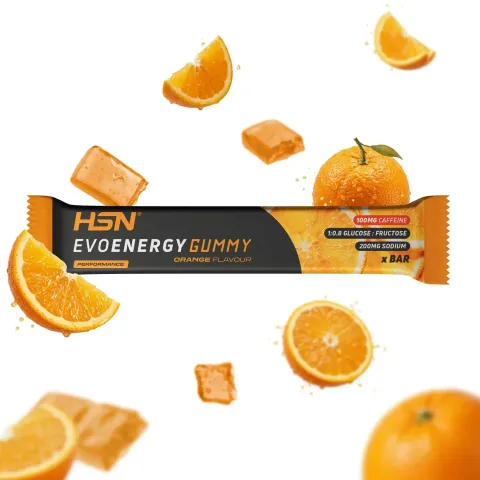
Chewy energy with an improved formula to train or compete without losing your rhythm
Evoenergy Gummy with Caffeine from SportSeries is a gummy candy bar with flavour, caffeine, and an improved formula.
It’s made for those moments when you want energy, but you’d rather have something solid that’s easy to eat. Its compact format of 30 g fits anywhere: in your cycling jersey, in the pocket of your shorts, on your running belt, or in your hydration backpack without taking up space. The idea is simple: carry a convenient option to deliver carbohydrates on the move, as a direct alternative to classic gels. When your workout gets longer or tougher, the key isn’t just to “get energy in”, it’s to do it in a practical way. A gummy-like texture makes all the difference: you chew it quickly, it goes down easily, and it lets you keep doing your thing.
A bar that adapts to your pace: quick, compact, and designed for eating while you’re in full action.
High glycemic index carbohydrates
During the session, what usually works best is the simple stuff: high availability carbohydrates your body can use quickly. Each bar provides about 21 g of carbohydrates and 87 kcal, coming mainly from sources like sugar and glucose and fructose syrups—this classic combo is what you go for when you want energy ready to use.
It’s an ideal option for long rides, demanding sets, climbs, changes of pace, or any situation where you want to keep intensity going without relying only on isotonic drink.
Gummy texture: a really practical way to add solid energy
The base with pectin gives you that gummy bite that’s easy to eat. Plus, the coating helps it feel nice to the touch and comfortable to handle without it “sticking” too much—whether to the wrapper or your hands. The result is a bar that’s easy to eat, especially useful when you don’t fancy a dense bar or when you want to alternate formats —drink, gel, and solid— without making it complicated.
Glucose:fructose ratio 1:0,8: know the details
One of the standout points of this improved formula is its glucose:fructose ratio 1:0,8. In sports nutrition, combining carbohydrate sources that are absorbed through different routes can help to improve the amount of carbohydrate that can be used during exercise and, at the same time, improve tolerance when the effort lasts longer. Jeukendrup and colleagues’ research has popularised exactly this “multiple transportable carbohydrates” approach, and studies with glucose/fructose mixes show benefits over using just one source.
In practice: Evoenergy Gummy fits especially well when you already have an intra-workout plan with gels and isotonic drink and you want solid options that keep delivering carbohydrates, without always depending on the same format.
100 mg of caffeine per bar
There are days when you need more than just carbohydrates. Evoenergy Gummy with Caffeine provides 100 mg of caffeine, an amount designed to be used strategically: before an intense workout, in the final stretch of a long session, or right before the key block of the training. Practically, caffeine is linked to a better sense of alertness and can help make the effort more manageable when the pace ramps up—so it’s so common in endurance sports and also in high-intensity sessions.
How to fit it into your planning
If you already know caffeine sits well with you, you can save it for when you really need it: that climb that costs you, that change of pace, that final part of the workout, or that early session. If you’re sensitive, the smartest thing is to test it in training before using it in competition, and avoid it very close to bedtime.
200 mg of sodium per bar: a handy extra
In sports where you sweat a lot —cycling, running, trail, triathlon, or intense indoor sessions—, sodium is a key point because it’s part of the electrolytes lost through sweat. Each bar provides 200 mg of sodium, which works really well on hot days, long training sessions, or situations where you notice you’re losing electrolytes. Just keep in mind that this amount doesn’t replace a complete hydration strategy, but it’s a very convenient way to add an extra when you’re on the move.
Practical protocols: learn how to use it
The beauty of Evoenergy Gummy with Caffeine is that it works for lots of scenarios and goes really well with isotonic drink and gels. The improved formula keeps that practical focus: you carry it with you, you eat it when you notice you need it, and you boost your intra-workout nutrition without hassle and without losing your rhythm.
Endurance: cycling, running, trail, and triathlon: In medium-to-long sessions, a comfortable option is to alternate formats: drink to keep supplying carbs and electrolytes steadily, and the bar as a solid bite when you need it most. As a base, you can go with Evotonic or Evocarbs 2.0, and leave Evoenergy Gel for the moments when you need something super quick, or when you don’t feel like eating anything solid. The caffeine bar fits especially well before a demanding stretch or when you’re looking for an alternative to the gel.
HIIT, cross training, and team sports: If your session is intense and of moderate duration, this bar can work as a quick source of carbs before you start, between blocks, or during the break, and the caffeine can be a useful extra depending on your needs. On very sweaty days, sodium is support within a complete hydration and mineral replenishment strategy.
Indoor hot training: winning combo with isotonic: When you train on a turbo trainer, treadmill, or group classes, sweating can be high even if you don’t realise it. That’s where it usually works really well to have a bottle with isotonic drink, or water and salts, and save the bar for those moments when you want to eat something, when the session is very long, or when you want to keep your carb intake going without relying only on liquid.
Scientific bibliography
- Currell, K., & Jeukendrup, A. E. (2008). Superior endurance performance with ingestion of multiple transportable carbohydrates. Medicine & Science in Sports & Exercise, 40(2), 275–281.
- Jentjens, R. L. P. G., Moseley, L., Waring, R. H., Harding, L. K., & Jeukendrup, A. E. (2004). Oxidation of combined ingestion of glucose and fructose during exercise. Journal of Applied Physiology, 96(4), 1277–1284.
- Rowlands, D. S., Houltham, S., Musa-Veloso, K., Brown, F., Paulionis, L., & Bailey, D. (2015). Fructose–glucose composite carbohydrates and endurance performance: Critical review and future perspectives. Sports Medicine, 45(11), 1561–1576.
- Rowlands, D. S., & collaborators. (2011). Fructose-maltodextrin ratio in a carbohydrate-electrolyte solution differentially affects exogenous carbohydrate oxidation rate, gut comfort and performance. American Journal of Physiology-Gastrointestinal and Liver Physiology, 300(1).
- Sawka, M. N., Burke, L. M., Eichner, E. R., Maughan, R. J., Montain, S. J., & Stachenfeld, N. S. (2007). American College of Sports Medicine position stand: Exercise and fluid replacement. Medicine & Science in Sports & Exercise, 39(2), 377–390.
- Spriet, L. L. (2014). Exercise and sport performance with low doses of caffeine. Sports Medicine, 44(Suppl 2), S175–S184.
- Jeukendrup, A., & Gleeson, M. (2019). Sport Nutrition (3rd ed.). Human Kinetics.