Heads up!
Pay close attention when choosing your R-ALA purchase, because many companies sell amounts of 'R-ALA' that are actually R-ALA Salts, making the indicated amount higher than the real one, misleading customers with unclear labeling.
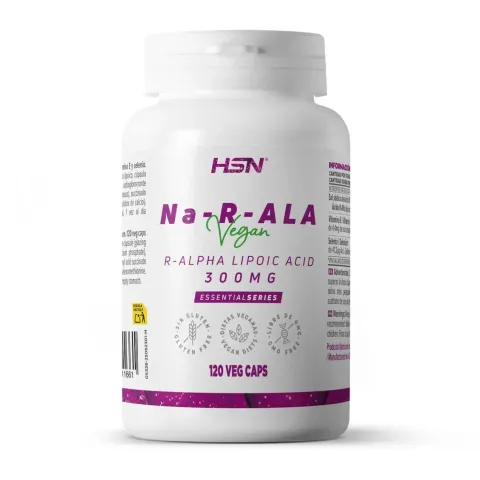
Our supplement provides: 300mg of R-Alpha-Lipoic Acid obtained from 365.8mg of Na-R-ALA salt.

R-Alpha Lipoic Acid 300mg - The ALA star of the moment
R-Alpha Lipoic Acid 300mg from EssentialSeries is HSN’s dietary supplement based on the R- isomer of Alpha-Lipoic Acid, in a stabilized form thanks to its presentation as a sodium salt. The high concentration formula is complemented with a significant dose of two key micronutrients: natural vitamin E and Selenium as Selenomethionine.
Alpha Lipoic Acid is a natural compound with the chemical name 1,2-dithiolane-3-pentanoic acid, also known as thioctic acid. It’s a compound commonly found in the mitochondria of living cells. It’s an 8-carbon fatty acid with thiol groups on carbons 6 to 8, first isolated in 1951 by scientist Reed, and first used clinically in 1959 at a US hospital.
HSN’s R-Alpha Lipoic Acid 300mg is vegan-friendly, made with R-ALA free from Genetically Modified Organisms.
A superior form of Lipoic Acid + All the HSN guarantees at your fingertips
100% Rectus Enantiomer. No S- enantiomer in the mix.
Our 'standard' Alpha-Lipoic Acid is the usual combination, and the most used in scientific studies, of the racemic mixture of R-/S- ALA. You can find it in:
However, this product is our Na-R-ALA version that exclusively provides the R- enantiomer of Alpha-Lipoic Acid. All raw material analyses and lab verifications show that 100% of HSN’s formula composition delivers pure R-ALA, with no S-ALA content. Just the natural form of ALA and nothing else.
Higher Bioavailability. Studies show R-ALA’s superiority
The dual opinions about ALA enantiomers come from the fact that the racemate combining R- and S-ALA is the most studied form, so its effectiveness is well proven and many users appreciate this.
Still, scientific studies show that R-ALA, being the natural form of Lipoic Acid found in nature and an important dietary source, may be superior.
Studies show the R- enantiomer of ALA has greater intestinal absorption than the R and S ALA mix.
Salehi et al. (2019) point out that the time to reach peak ALA concentrations is shorter for the R- isomer than for the S- and the peak concentrations reached at equal doses are 40 to 50% higher.
R-ALA’s bioavailability is higher than forms containing S-ALA, with the advantage of combining both enantiomers being improved stability, since R-ALA, despite its superior bioavailability, easily polymerizes and loses its properties. That’s why stabilization is necessary.

Stabilized form - Sodium salt 'Na-R-ALA' to guarantee effectiveness
Because of this, R-ALA’s effectiveness was questioned in practice until the 'stable form' of R-ALA arrived: its sodium salt or 'Na-R-ALA', proven to be more stable than the R-ALA 'base'.
R-ALA gradually breaks down at room temperature and easily polymerizes above its melting point, so R-ALA stability is crucial for its use, and to achieve this conveniently and effectively, it’s combined with sodium to form a new complex 'Na-R-ALA' with guaranteed stability.
Studies like Carlson et al. (2007) show that R-ALA sodium salt is less prone to polymerization, improves water solubility, and shows a higher maximum concentration and a shorter time to reach peak concentration than base R-ALA or the racemic R and S ALA mix.
300mg of R-ALA base | Clear, honest info. Here’s the deal
Many companies we’ve checked aren’t transparent or at least provide info that can be confusing, why is that?
Because R-ALA sodium salt contains 18% sodium by composition, and obviously, that sodium isn’t Alpha Lipoic Acid nor does it have ALA’s biological effects, it’s just used to stabilize R-ALA.
Our product provides 300mg of R-ALA per veggie capsule, these 300mg of ALA come from 365.8mg of R-ALA sodium salt, with 65.8mg being the sodium content.
Well, other companies declare the full salt as R-ALA, and even if they specify it’s Na-R-ALA, they don’t declare the actual R-ALA content in the full salt, making people unaware that part is sodium without ALA’s biological effects, and mistakenly think that fraction is also R-Alpha Lipoic Acid.
At HSN you’ll find complete, clear, and transparent info about our products.
Product properties - Don’t miss out on its benefits
The formula stands out especially for protecting cells against oxidative damage, thanks to its vitamin E content.
Also, it contributes to normal spermatogenesis, an effect attributed to selenium.
Natural sources of ALA. Do we get Alpha-Lipoic Acid from our diet?
ALA in the R- enantiomer form can be found in foods, mainly fruits, vegetables, and red meats, especially organ meats. Some foods that provide significant Alpha Lipoic Acid are:
- Spinach.
- Broccoli.
- Tomatoes.
- Kidneys.
- Heart.
- Liver.
All the ALA in these foods is present as Lipoyllysine complex, a molecule of ALA bound to the amino acid lysine, which is how ALA binds to proteins for storage.

Anyway, ALA doesn’t accumulate in the body, which explains its safety and lack of side effects, unused ALA is almost completely eliminated in urine within 24 hours of intake.
How long does it take to work? Does it affect differently depending on age or sex?
ALA is absorbed between 30 and 60 minutes after oral intake, reaching peak concentration around 30 minutes for the R- form and 60 minutes for the R- + S- mix.
ALA bioavailability is considered higher in older adults, as compared to people aged 18 to 45, they utilize the same amount of Alpha Lipoic Acid better.
There are no absorption differences between men and women at low doses, but at high doses (600mg) women utilize ALA better than men.
Ideal supplements to combine with ALA. Don’t miss them!
R-ALA complements any other product, with no contraindications for use alongside any other dietary supplement.
It’s generally recommended to use it together with Gluco Care.
As a compound related to mitochondria, where ALA is found, it’s recommended to use it together with L-Carnitine.
References
- Gosselin, L. E., Chrapowitzky, L., & Rideout, T. C. (2019). Metabolic effects of α-lipoic acid supplementation in pre-diabetics: A randomized, placebo-controlled pilot study. Food and Function, 10(9), 5732–5738.
- Ziegler, D., & Gries, F. A. (1997). Α-Lipoic Acid in the Treatment of Diabetic Peripheral and Cardiac Autonomic Neuropathy. Diabetes, 46(SUPPL. 2), S62-6.
- Kucukgoncu, S., Zhou, E., Lucas, K. B., & Tek, C. (2017). Alpha-lipoic acid (ALA) as a supplementation for weight loss: results from a meta-analysis of randomized controlled trials. Obesity Reviews, 18(5), 594–601.
- Salehi, B., Berkay Yılmaz, Y., Antika, G., Boyunegmez Tumer, T., Fawzi Mahomoodally, M., Lobine, D., … Sharifi-Rad, J. (2019). Insights on the use of α-lipoic acid for therapeutic purposes. Biomolecules, 9(8).
- Carlson, D. A., Smith, A. R., Fischer, S. J., Young, K. L., & Packer, L. (2007). The plasma pharmacokinetics of R-(+)-lipoic acid administered as sodium R-(+)-lipoate to healthy human subjects. Alternative Medicine Review, 12(4), 343–351.