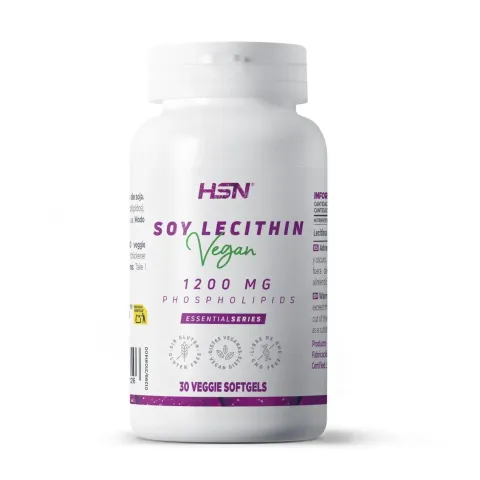
Natural phospholipids in vegan pearls
Soy lecithin 1200mg from EssentialSeries is a dietary supplement in vegan pearls that contains a high concentration of natural phospholipids derived from soy lecithin obtained through the natural mechanical pressing of soybeans to extract their raw virgin oils.
Soy lecithin is used worldwide for culinary reasons, as it is an excellent emulsifier, but due to its unique nutritional properties that many people want to benefit from, its phospholipids have been extracted in oily forms to maximize their benefits.
HSN’s soy lecithin phospholipid pearls are coated with a vegetarian, not animal, agent, making them fully suitable for vegan diets.
Natural phospholipids - with the best quality controls
We’re committed to the environment and sustainability
Soy is currently the crop species most subjected to genetic modifications to resist herbicides and pests. More than 75% of the soy grown worldwide is genetically modified, meaning it’s genetically engineered (ISAAA, 2019).
At HSN we’re aware of the concerns users have about consuming products derived from genetically modified organisms, not to mention the environmental impact caused by genetic engineering.
For all these reasons, and to keep our commitment to consumers and sustainable production:
We’ve selected raw material that uses natural soybeans, without genetic modifications.
Most products on the market with soy lecithin come from GMO soy because it’s cheaper. We don’t care about that, and prefer to bring you a product with natural raw material cultivated using traditional methods.
Extracted following mechanical procedures
Soy lecithin presented in oil form, due to its high extracted phospholipid content, can be processed in many ways, with the use of chemical solvents like hexane, acetone, petroleum ether, or benzene being the favorite method for companies.
At HSN we use mechanical procedures to extract natural soy oil, which essentially consist of pressing the cultivated soybeans to get their oily content, rich in lecithin, which is separated by heating the natural oil with water, and then the phospholipids are concentrated from the lecithin treatment.
Enjoy a high-concentration soy lecithin supplement made following the best extraction methods from natural soybeans.
High concentration: 1200 mg of pure phospholipids per pearl
We recommend taking 2 vegan pearls a day to get a net dose of 2400 mg of soy lecithin phospholipids.
This high dose is effectively achieved with so few pearls, thanks to the high unit concentration of soy lecithin phospholipids in each one, no less than 1200 mg.
At HSN we not only work on finding the best raw materials and developing the best formulas, but also strive to follow the best procedures to obtain products of the highest quality, concentration, and effectiveness.
Don’t miss our high-concentration (1200 mg) soy lecithin pearls.
Advantages of soy lecithin over other lecithin sources
Lecithins aren’t only found in soy; they’re components of cell membranes in many plants and are also present in animals and humans, especially in nervous system cells where they form part of neuron cell walls.
Other foods with high lecithin concentrations include cottonseed and sunflower oils, and especially egg yolks.
However, soy lecithin offers certain benefits superior to other sources, such as having phosphatidylinositol content at about 15% of total phospholipids, significantly higher than any other source like egg or sunflower.
HSN and product development for everyone
At HSN we know that part of the population is vegan, and that this shouldn’t be a barrier to consuming dietary supplements, so when developing our products we pay close attention to ingredient selection to exclude animal-derived food sources.
Soy lecithin is a plant-based source, suitable for vegans, but its phospholipid content means it’s oily in form.
This means it needs to be coated in pearls to prevent spilling, and most competitor pearls are made with gelatin, which comes from cartilage structures of animals like cows and pigs.
Why should a product that can be perfectly vegan stop being so because of excipients?
At HSN we strongly oppose this!
We use the latest technological advances in dietary supplement production to develop softgels with plant-based coating agents.
Our pearls are made with starch, a coating agent derived from cereals and completely valid for vegan consumption.
The soy lecithin properties you’re looking for
Soy lecithin is very rich in phospholipids, among which phosphatidylcholine stands out as the most abundant type. This phospholipid provides choline which, according to estimates from scientific studies, would release around 1.67 - 2.2% of the total composition, being higher in our product as it contains pure phospholipids.
Choline is a nutrient with nutritional properties, such as contributing to normal homocysteine metabolism, normal lipid metabolism, and maintaining normal liver function.
Soy lecithin: Rich in important nutrients
According to scientific studies, the composition of liquid soy lecithin (oil form) is:
- Phosphatidylcholine: 12.69-16.7%
- Phosphatidylinositol: 6.47-11.84%
- Phosphatidylethanolamine: 6.45-13.57%
- Phosphatidic acid: 2.28-5.96%
A broad spectrum of important phospholipids for the natural composition of this plant structure, with a significant supply of phosphatidic acid, a nutrient very scarce in the diet, sought after by athletes, hence the widespread use of soy lecithin among bodybuilding users.
Recommended combinations
According to multiple scientific studies, soy lecithin has been used, for its properties as a lipid carrier, with other agents to increase its bioavailability. These include:
Therefore, it’s recommended to use soy lecithin together with one or more of these supplements to optimize their combined use.
Is soy lecithin for me? Recommendations
Soy lecithin is widely used by people interested in maintaining a varied and healthy diet, as well as by athletes, especially in bodybuilding and strength sports.
Also available in granules - ideas
Don’t miss the soy lecithin granules from FoodSeries. Rich in natural phospholipids, ideal for culinary uses.
- Baked goods: As a partial substitute for fats like butter or oils in cakes, for example.
- Soups and sauces: To increase thickness, used as a 'texturizer' to make them creamier.
- Dressings: Helps emulsify the oil and water phases of dressings (e.g., oil and vinegar).
- Beverages: Ideal in shakes, milkshakes, and fruit or dairy smoothies, helps boost nutritional richness and improve both texture and taste.
- Desserts: Used as an emulsifier to make ice creams and chocolates, helping stabilize dairy refrigeration and reduce crystal formation during freezing.
Bibliographic references
- Knuiman, J. T., Beynen, A. C., & Katan, M. B. (1989). Lecithin intake and serum cholesterol. American Journal of Clinical Nutrition, 49(2), 266–268.
- Gauss, A., Ehehalt, R., Lehmann, W. D., Erben, G., Weiss, K. H., Schaefer, Y., … Gotthardt, D. N. (2013). Biliary phosphatidylcholine and lysophosphatidylcholine profiles in sclerosing cholangitis. World Journal of Gastroenterology, 19(33), 5454–5463.
- International Service for the Acquisition of Agri-biotech Applications (2019). Biotech crop annual updates - Soybeans.